
We offer you an apple marshmallow recipe. Homemade marshmallows made according to this recipe are a delicious, light airy treat.
Summary
| Prep Time | 1 hr 30 mins |
| Cook Time | 30 mins |
| Total Time | 1 day |
| Course | Dessert |
| Cuisine | Russian |
 Ingredients
 Ingredients
- Sour apples – 900-1000 g
- Sugar – 250 g
- Vanilla sugar – 10 g
- Egg white – 1 pc.
For syrup:
- Water – 140 ml
- Lemon juice – 20 ml
- Sugar – 475 g
- Agar-agar – 8 g
 Print Recipe
 Pin Recipe
 Instructions
- We prepare products for apple marshmallows.
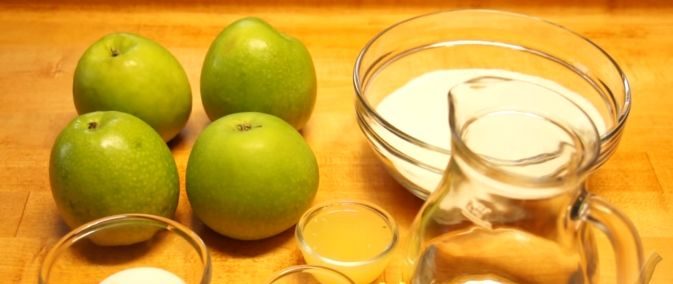
- Let’s make the applesauce. 4 large sour apples, cut in half, remove the core and the stalk.
- Cook in a double boiler or bake in the oven for 20-30 minutes, until tender.
- While the apples are boiling, soak the agar-agar. To do this, pour 140 milliliters of water into a saucepan, add 20 milliliters of lemon juice and 8 grams of agar-agar, mix and set aside.
- Peel the finished apples and rub through a sieve. Add 250 grams of granulated sugar and 10 grams of vanilla sugar, mix. Leave to cool for about 1 hour.
- After an hour, put the pan with agar-agar on the fire, bring it almost to a boil, add 475 grams of sugar and stir all the time until the sugar is completely dissolved.
- Boil the syrup until sample on a thin thread (up to 110 degrees Celsius), stirring from time to time. Remove from heat and let cool slightly, to about 100 degrees.
- While the syrup is cooling, beat the cooled applesauce with a mixer, while beating, add one egg white in two steps.
- We continue to beat until a fluffy white mass is obtained. The mass has increased in volume by 2.5 times. Without stopping whipping, add syrup cooled to 100-105 degrees in a thin stream. Beat until a white, fluffy, and dense mass is obtained (the mass increases in volume by 2.5 times).
- We transfer the marshmallow mass into a pastry bag with a toothed nozzle and place cakes of the same size on baking paper. We leave the marshmallow at room temperature for a day so that it dries a little.
- Sprinkle the dried marshmallows with powdered sugar. Glue in pairs put on a dish.
- The apple marshmallow is ready. We serve delicious, delicate, and airy fruit desserts to the table.


About Editorial Staff
The Boss Kitchen editorial staff oversees content review, fact-checking, and recipe verification across the site. Published articles pass through the editorial team before going live, ensuring ingredient lists, techniques, cooking times, and nutritional claims hold up in a home kitchen. The team coordinates contributions across the site writers, handles reader corrections, and maintains consistency in measurement conventions, safety guidance, and dietary labeling. Posts under this byline typically represent team-reviewed reference material, site announcements, or editorial roundups rather than individual-author features, and they are held to the same sourcing standards as bylined recipe and product coverage.
Get FREE Recipe Gifts now. Or latest free cooktops from our best collections.
Disable Ad block to get all the secrets. Once done, hit any button below