Sauerkraut – crisp like January snow! Snow-white and pink … It just asks: “Eat me!”
Summary
| Prep Time | 30 mins |
| Total Time | 3 days |
| Course | Main Dish |
| Cuisine | Russian |
 Ingredients
 Ingredients
For a 3 liter jar:
- White cabbage – 4 kg
- Medium carrots – 1 pc.
- or beets – 0.5 pc. (for 1.2 kg of cabbage)
- Rock salt (not iodized)

 Print Recipe
 Pin Recipe
 Instructions
- We start the pickling by choosing cabbage: it should not have putrefactive spots; the color of the cabbage should be uniform and practically not have a green tint (if the cabbage is yellow, then it is not suitable for salting, since it was stored under improper conditions); veins should be small, leaves are thin; the head of the cabbage must be firm and firm.
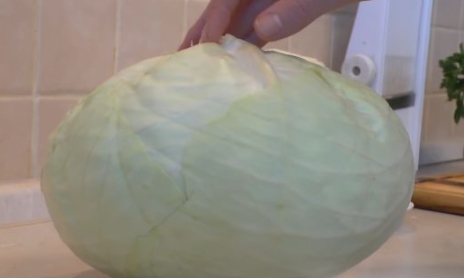
- Divide the head of cabbage into 4 parts (it is more convenient to chop this way) and, if there are black dots, cut them out. Then finely chop the cabbage using a shredder (or knife).
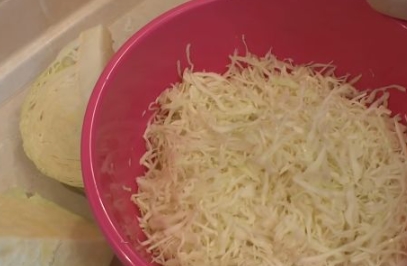
- Mix half of the cabbage with grated carrots (do not add too many carrots, because they contain a lot of sugar and the cabbage will develop a bitter taste during fermentation).
- We take ordinary table salt, without adding iodine. Salt the cabbage to taste (like a salad): add a little salt and taste. We leave at room temperature for 5-6 minutes so that the cabbage starts up the juice. The main thing is not to overexpose the cabbage, because it will begin to oxidize and a yellow color will appear.
- Put some cabbage in a dry clean jar and tamp it until the juice is released.
- Thus, we continue to fill the jar with cabbage, but not to the brim, because a lot of juice is released during fermentation.
- To make pink sauerkraut, mix the rest with grated beets, also with a little of it, because beets also contain a lot of sugar. Sprinkle with salt.
- We fill the jar with pink cabbage in the same way.
- We cover the jars with saucers and put them in a container where the liquid will drain.
Leave the cabbage for about 3 days. (Ideal conditions are 17 degrees, but if the room temperature is higher – about 23 degrees, the cabbage will cook quickly, in 2-3 days.) - The sauerkraut is very juicy and crispy. The only difference between pink and white cabbage is that pink is slightly sweeter.
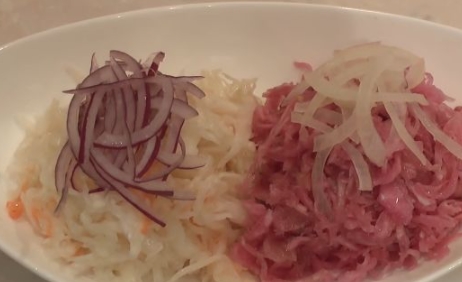
- Let homemade sauerkraut always be on your table!
Bon Appetit!


About Editorial Staff
The Boss Kitchen editorial staff oversees content review, fact-checking, and recipe verification across the site. Published articles pass through the editorial team before going live, ensuring ingredient lists, techniques, cooking times, and nutritional claims hold up in a home kitchen. The team coordinates contributions across the site writers, handles reader corrections, and maintains consistency in measurement conventions, safety guidance, and dietary labeling. Posts under this byline typically represent team-reviewed reference material, site announcements, or editorial roundups rather than individual-author features, and they are held to the same sourcing standards as bylined recipe and product coverage.
Get FREE Recipe Gifts now. Or latest free cooktops from our best collections.
Disable Ad block to get all the secrets. Once done, hit any button below