I would never have thought that salted caramel is delicious! But in the chocolate tart recipe, it is harmoniously combined with sweet chocolate ganache. I recommend you try it too.
Summary
| Cook Time | 15 mins |
| Course | Dessert |
| Servings (Default: 16) |
 Ingredients
 Ingredients
- For the dough:
- Flour – 200 g
- Almonds (crumb) – 30 g
- Cocoa powder – 10 g
- Powdered sugar – 50 g
- Salt – 1 pinch
- Vanilla sugar – 1 sachet
- or vanillin – 1 pinch
- Butter – 90 g
- Egg – 35 g
- For syrup:
- Sugar – 2 cups
- Water – 1 glass
- Citric acid – 2 g
- Soda – 1.5 g
- For caramel:
- Cream (15%) – 200 g
- Butter – 150 g
- Sugar – 190 g
- Milk – 190 g
- Glucose syrup – 185 g
- For ganache:
- Cream (15%) – 150 g
- Chocolate – 150 g

Instructions
- Sift flour, icing sugar and cocoa powder through a sieve (preferably several times). Then combine with chopped almonds.
- Add butter, a pinch of salt and vanilla powder.
- Stir in a food processor or mixer for 3 minutes until smooth. Then mix with a spatula, collecting the dough from the sides, and beat for another 2-4 minutes.
- Beat the egg and measure out 35-38 g.
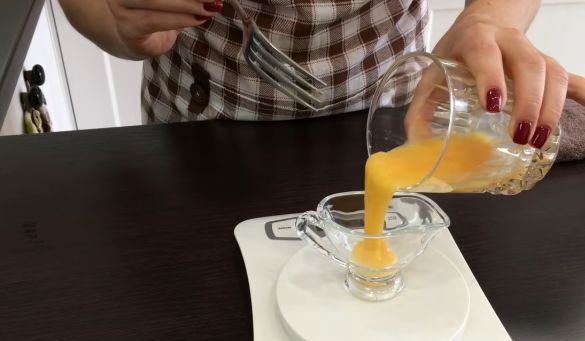
- Add the egg to the rest of the ingredients and mix for no more than 1 minute.
- Recipe preparation photo: Chocolate ganache and salted caramel tart – step # 7
Give the dough the shape of a ball and cut off a small piece. - Roll out the shortcrust pastry 0.5 cm thick and cut out a circle with a diameter of 8 cm.
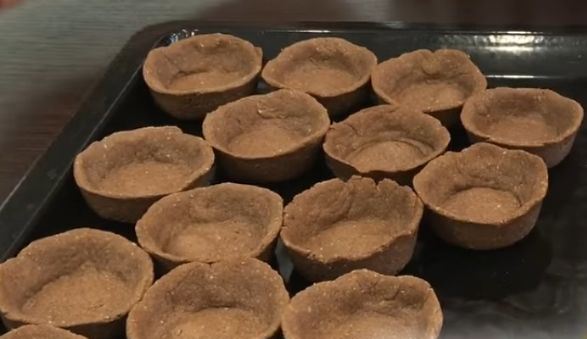
- Using a knife, transfer to muffin molds and lower to the bottom, press the bottom and sides with a mortar. Thus, we proceed with the entire dough (from the specified number of ingredients, 16 blanks are obtained). We send it to the freezer for 10-15 minutes.
- Preheat the oven to 160 degrees. Then we bake the tarts for 15 minutes.
- Let’s start making glucose syrup. We send 2 glasses of sugar and 1 glass of water to the pan. We put on fire and, stirring constantly, wait until the sugar dissolves. Then add citric acid, stir and bring to a boil.
- Reduce heat to almost minimum, cover and leave for 10 minutes. We lower the culinary thermo to the center of the pan, but without touching the bottom, and measure the temperature (it should reach 115 degrees). Then turn off and leave for 10 minutes to cool the syrup a little.
- Add soda to glucose syrup. Mix well. The syrup immediately begins to foam, after 10-15 minutes the foam will disappear.
- The invert syrup is ready, it should turn out to be stringy.
- Let’s start making a creamy salted caramel. Add 185 g of invert syrup, sugar, milk, soft butter and fine salt to a saucepan.
- Stirring constantly with a wooden spatula, first heat it over high heat. Then reduce heat to medium and stir until all ingredients are melted and mixed. We taste it, add another 0.25 teaspoons of salt if desired.
- Increase the heat and, stirring constantly with a wooden spatula, cook the caramel for 12 minutes. We measure the temperature – it should be 140 degrees.
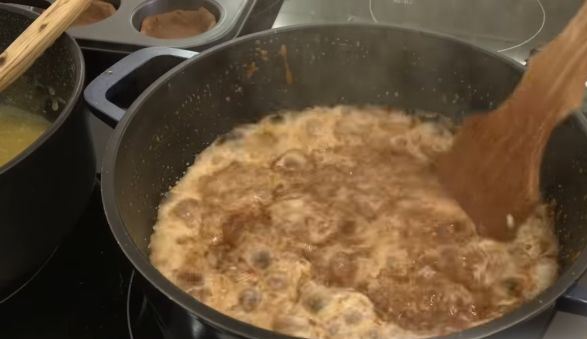
- Turn off the heat and add the cream – stir. Leave to cool for 10-15 minutes, then pour into another container and send to the refrigerator.
- Cooking chocolate ganache. We heat the cream (but do not boil it). When the first bubbles appear, turn off the heat. Add chocolate to the cream and mix thoroughly until the mass becomes homogeneous.
- Cut the edges of the cooled tartlets with a grater so that they are even.
- Fill the tarts with salted caramel.
- We send it to the refrigerator for 10-15 minutes. Then move it to the freezer for 20 minutes.
- Top with chocolate ganache.
- The tart with chocolate ganache and salted caramel is ready. We decorate at our discretion. Bon Appetit everyone!


About Editorial Staff
The Boss Kitchen editorial staff oversees content review, fact-checking, and recipe verification across the site. Published articles pass through the editorial team before going live, ensuring ingredient lists, techniques, cooking times, and nutritional claims hold up in a home kitchen. The team coordinates contributions across the site writers, handles reader corrections, and maintains consistency in measurement conventions, safety guidance, and dietary labeling. Posts under this byline typically represent team-reviewed reference material, site announcements, or editorial roundups rather than individual-author features, and they are held to the same sourcing standards as bylined recipe and product coverage.
Get FREE Recipe Gifts now. Or latest free cooktops from our best collections.
Disable Ad block to get all the secrets. Once done, hit any button below