Do you already think what dishes to cook for the New Year’s table 2019? I would like to offer you a festive version of a truly Russian pastry called “kulebyaka” in the spirit of the coming Year of the Pig, namely, in the form of a rosy pig!
Summary
| Cook Time | 5 hours 50 minutes |
| Total Time | 5 hours 50 minutes |
| Course | Main Dish |
 Ingredients
 Ingredients
For the dough:
- Milk – 210 g
- Sugar – 60 g
- Eggs – 1 pc.
- Vegetable oil – 60 g
- Dry yeast – 9 g
- Flour – 470 g
- Salt – 0.5 teaspoon

For filling:
- Minced beef – 380 g
- Rice – 70 g
- Eggs – 1 pc.
- Parsley to taste
- White cabbage – 200 g
- Salt to taste
- Ground black pepper – to taste
- Vegetable oil – for frying
- Butter (optional) – to taste
For pancakes:
- Flour – 70 g
- Eggs – 1 pc.
- Sugar – 0.5 tbsp
- Salt – a pinch
- Water – 150 g
 Print Recipe
 Pin Recipe
 Instructions
- So, first of all, we prepare products for kulebyaki with three fillings. It is most convenient to prepare all the fillings and bake pancakes at the very beginning, and only then proceed to kneading the dough, forming and baking a festive poultry cake in the form of a pig.
- Cooking meat filling. Fry the minced pork and beef in a frying pan, salt and pepper to taste.
- Cooking rice filling, for which we boil rice and an egg. Then mix the chopped egg, herbs and rice, salt to taste. If you like it juicier, add butter.
- Shred cabbage and simmer in a pan, also add salt and pepper to taste.
- For pancakes, whisk together flour, salt, sugar, egg and water. Pouring a ladle of dough into a pancake pan, fry all 6 pancakes.
- When we have prepared all three fillings and baked the pancakes, you can start kneading the yeast dough. To do this, mix 200 grams of flour with yeast in a small bowl.
- Pour milk here, add sugar, mix until smooth.
- Pour the rest of the flour into a large bowl, leaving 2 tablespoons of the flour on the ground. Pour the prepared yeast mixture into the flour and add salt.
- Add a chicken egg, which must first be shaken, leaving just a little bit for greasing the kulebyaki. We mix all the ingredients.
- Then pour in vegetable oil and continue kneading.
- Then we lay out the still heterogeneous dough on the work surface, dusty with the remaining flour, and begin to actively knead it.
- If you are kneading the dough with your hands, continue to knead for at least 10 minutes. It should be elastic.
- We transfer it to a clean bowl, cover with a towel and leave for 1.5 hours to rise.
- After the indicated time, the dough will rise well.
- We knead it and leave it for another 20 minutes.
- Then we spread the dough on a work surface, dusty with flour, and cut off a small part of the dough to form the “ears”, “eye”, “patch” and “tail” of the pig.
- We roll out most of the dough into a rectangle about 25 cm wide, not more, and about 40 cm long. With such dimensions, the kulebyak will then fit well on a baking sheet. The thickness is about 0.7-1 cm.
- In the center of the dough, retreating slightly from the edges at the top and bottom, lay out the meat filling.
- We cover it with two pancakes, overlapping them.
- Put the rice filling with egg and herbs on top.
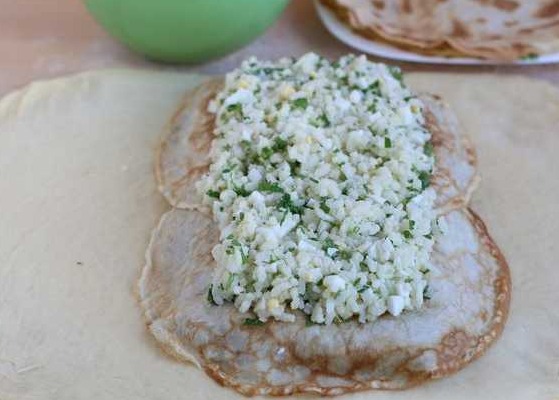
- Also cover the rice filling with two pancakes. Place the cabbage on top.
- Cover the cabbage with two pancakes.
- Then we raise the edges of the dough over the filling and connect them.
- We connect the edges of the kulebyaki from above and below.
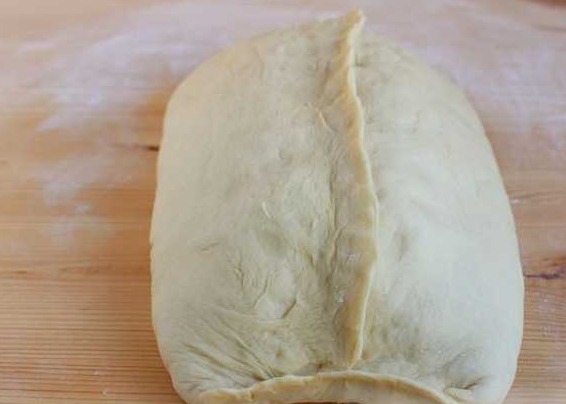
- Turn the kulebyaka over onto parchment paper so that the seam is at the bottom.
- We transfer the parchment with the kulebyaka to a baking sheet.
- From the remaining dough, pinch off a small piece and form a “patch” out of it. Roll the rest of the dough into a small rectangle, cut out the “ears” for the pig.
- With the help of the nozzle for the cream, I made “eyes” for the pig, let’s not forget to make the “tail”. If you want, you can also cut different shapes from the remaining dough to decorate the pig to your liking.
- We attach all the blanks to the kulebyaka using toothpicks, and when the kulebyaka is baked, they can be easily pulled out. In the “eyes” you can insert a highlight. Lubricate the kulebyaka with the remaining egg. Let it stand for about twenty minutes, and during this time we heat the oven to 180 degrees, after which we put the kulebyaka with meat, rice and cabbage to bake.
- Kulebyaka is baked for about 40 minutes, until browning. We take out the pig-shaped kulebyaka from the oven and immediately remove the toothpicks.
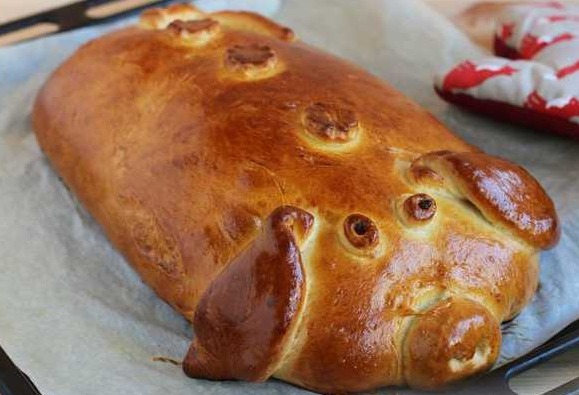
- After cooling, the kulebyak can already be cut.
- I strongly advise you to bake such a kulebyaka with three fillings for the New Year’s table.
Bon Appetit!


About Editorial Staff
The Boss Kitchen editorial staff oversees content review, fact-checking, and recipe verification across the site. Published articles pass through the editorial team before going live, ensuring ingredient lists, techniques, cooking times, and nutritional claims hold up in a home kitchen. The team coordinates contributions across the site writers, handles reader corrections, and maintains consistency in measurement conventions, safety guidance, and dietary labeling. Posts under this byline typically represent team-reviewed reference material, site announcements, or editorial roundups rather than individual-author features, and they are held to the same sourcing standards as bylined recipe and product coverage.
Get FREE Recipe Gifts now. Or latest free cooktops from our best collections.
Disable Ad block to get all the secrets. Once done, hit any button below